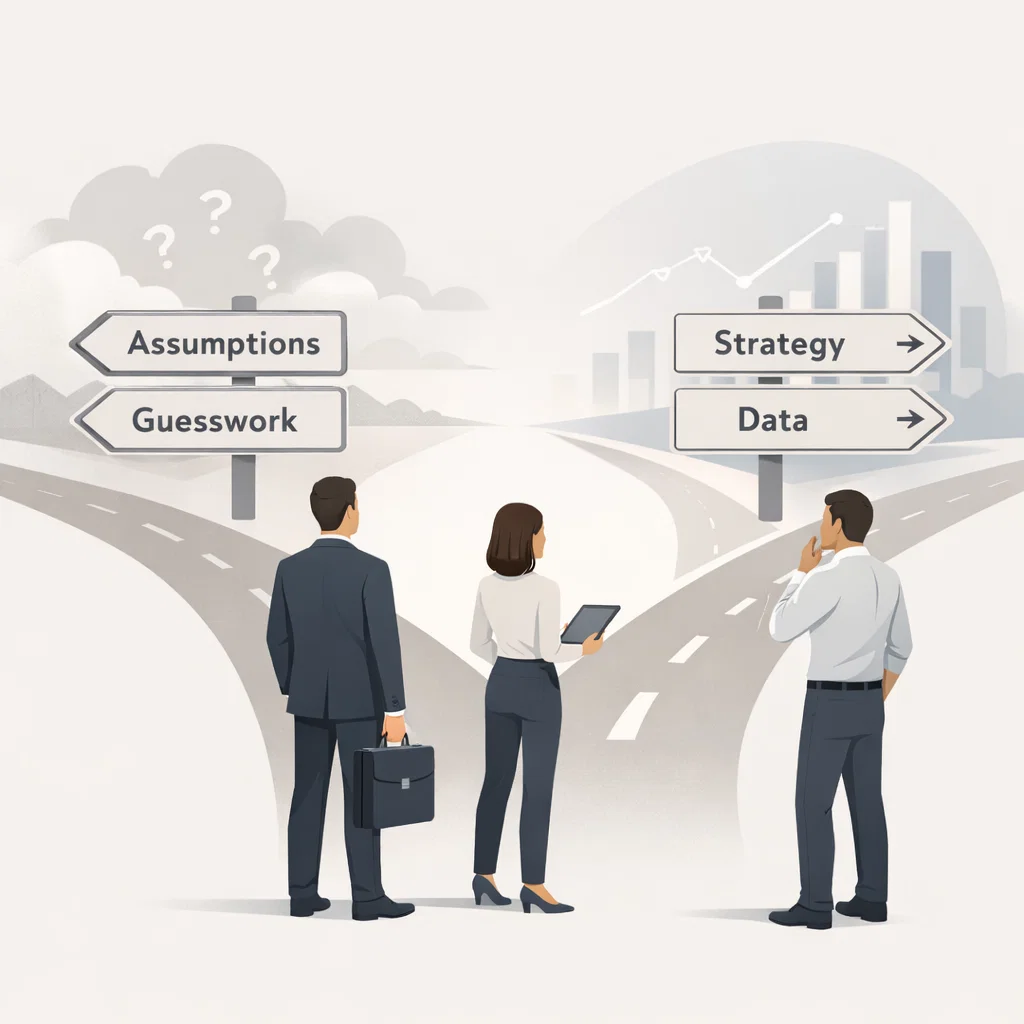
Most businesses struggling digitally are not careless or uninformed. On the contrary, they are usually active: they have a website, run ads, post on social media, sometimes invest in software or external services. Yet despite all this effort, results fail to improve.
At this point, familiar questions arise:
“Is the agency wrong?”
“Is the budget too small?”
“Is the market difficult?”
What is rarely asked is the real question:
“Which decisions did we make — and why?”
Most digital problems are not technical. They are the result of small but critical decision errors that accumulate silently over time. Individually, they seem harmless. Together, they slowly push the business off course.
This article examines six of the most common decision mistakes businesses make in digital operations — mistakes that are usually noticed only when it is already too late.
One of the most damaging mistakes is thinking about digital activities in isolation. Websites are seen as “corporate presence,” ads as “sales,” social media as “visibility,” and software as “operations.”
Internally this separation may feel logical. Externally, from the customer’s perspective, it does not exist. Customers experience all digital touchpoints as one single journey. When messaging, intent, and direction are inconsistent, trust erodes.
A common real-world scenario:
Ads bring traffic to a website, but the site offers no clear next step. Visitors leave. The conclusion becomes “ads don’t work.” In reality, the failure lies in a broken decision chain, not the channel itself.
Speed is often glorified in digital environments. Businesses rush to act so they do not “fall behind.” Decisions are made quickly, often without a clear understanding of long-term impact.
Digital decisions, however, compound over time. A rushed choice becomes infrastructure. Infrastructure becomes habit. Habit becomes dependency. By the time the mistake is visible, reversing it is costly.
This is how companies end up saying:
“We know this was a wrong choice, but changing it now is impossible.”
That sentence is the hidden cost of impulsive digital decisions.
A digital action is taken, but success is never clearly defined.
What exactly should change if this works?
More calls?
More qualified leads?
Shorter sales cycles?
Lower operational cost?
When outcomes are not defined in advance, performance cannot be evaluated later. Businesses then rely on vague impressions instead of facts, leading to inconsistent decisions and constant trial-and-error.
Most businesses today collect data. Analytics dashboards exist. Reports are generated. Numbers are visible. Yet very few of these numbers actively influence decisions.
Data without interpretation is noise.
Data without action is burden.
When insights fail to translate into concrete decisions, complexity increases rather than clarity.
When results disappoint, blame often shifts outward: agencies, platforms, competition, market conditions. While these factors can matter, focusing exclusively on them prevents internal decision-making from being examined.
This leads to repeated cycles: changing vendors, tools, or channels — while the same mistakes persist.
What remains unchanged is how decisions are made.
Operational pressure keeps businesses moving constantly. Rarely do they stop to ask:
“Where are we actually going?”
Without this pause, digital initiatives accumulate without direction. Activity increases, progress does not. Fatigue replaces momentum.
None of these mistakes come from ignorance. They stem from well-intentioned but fragmented decision-making. Businesses that succeed digitally are not those doing more — but those making fewer, better-aligned decisions.
When digital efforts fail, the solution is rarely “more tools” or “more budget.”
The real solution starts with one question:
“Which decision did we get wrong — and why?”

 Turkey (Türkçe)