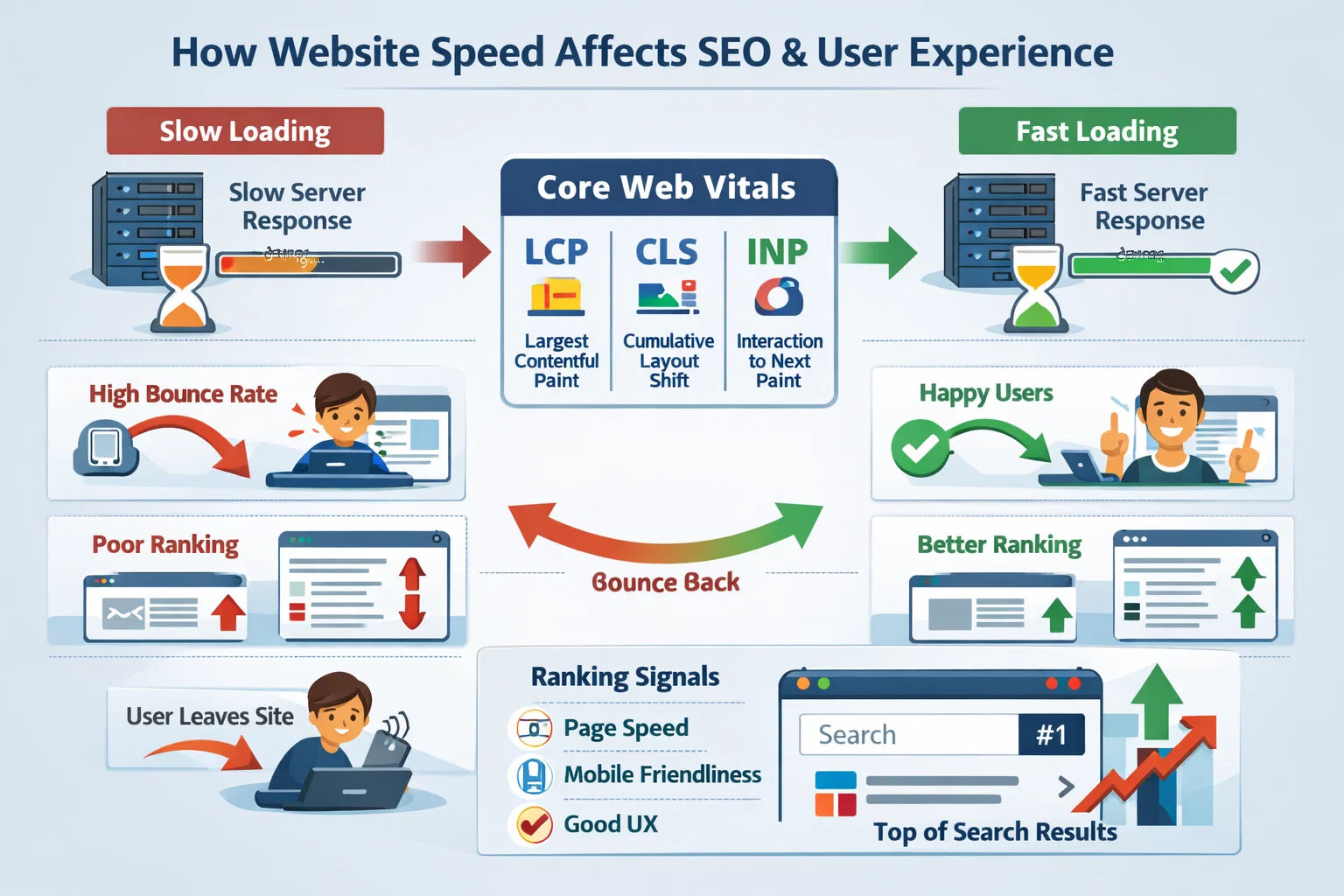
Website speed refers to how quickly a web page becomes usable in a visitor’s browser. Today, it plays a direct role in search engine rankings, user satisfaction, and conversion performance.
Search engines evaluate fast-loading websites as more user-friendly, making speed a core component of technical SEO strategies.
Research shows that as page load time increases, the likelihood of users leaving the site rises significantly. Mobile users, in particular, expect fast and responsive pages.
Google officially considers site speed as a ranking factor. Slow websites may struggle to compete in both desktop and mobile search results.
Additionally, poor performance can reduce crawl efficiency, delaying indexation of new or updated content.
Core Web Vitals are Google-defined metrics that measure real-world user experience:
LCP measures loading performance, CLS evaluates visual stability, INP measures interaction responsiveness.
Performance depends on server resources, software optimization, and content structure. Properly configured web hosting solutions with sufficient resources form the foundation of fast websites.
Fast websites inspire trust and encourage engagement. Even minor delays in load time can negatively affect conversion rates.
Website speed is not a minor technical detail; it is a fundamental factor for SEO success, user satisfaction, and long-term business growth.

 Turkey (Türkçe)