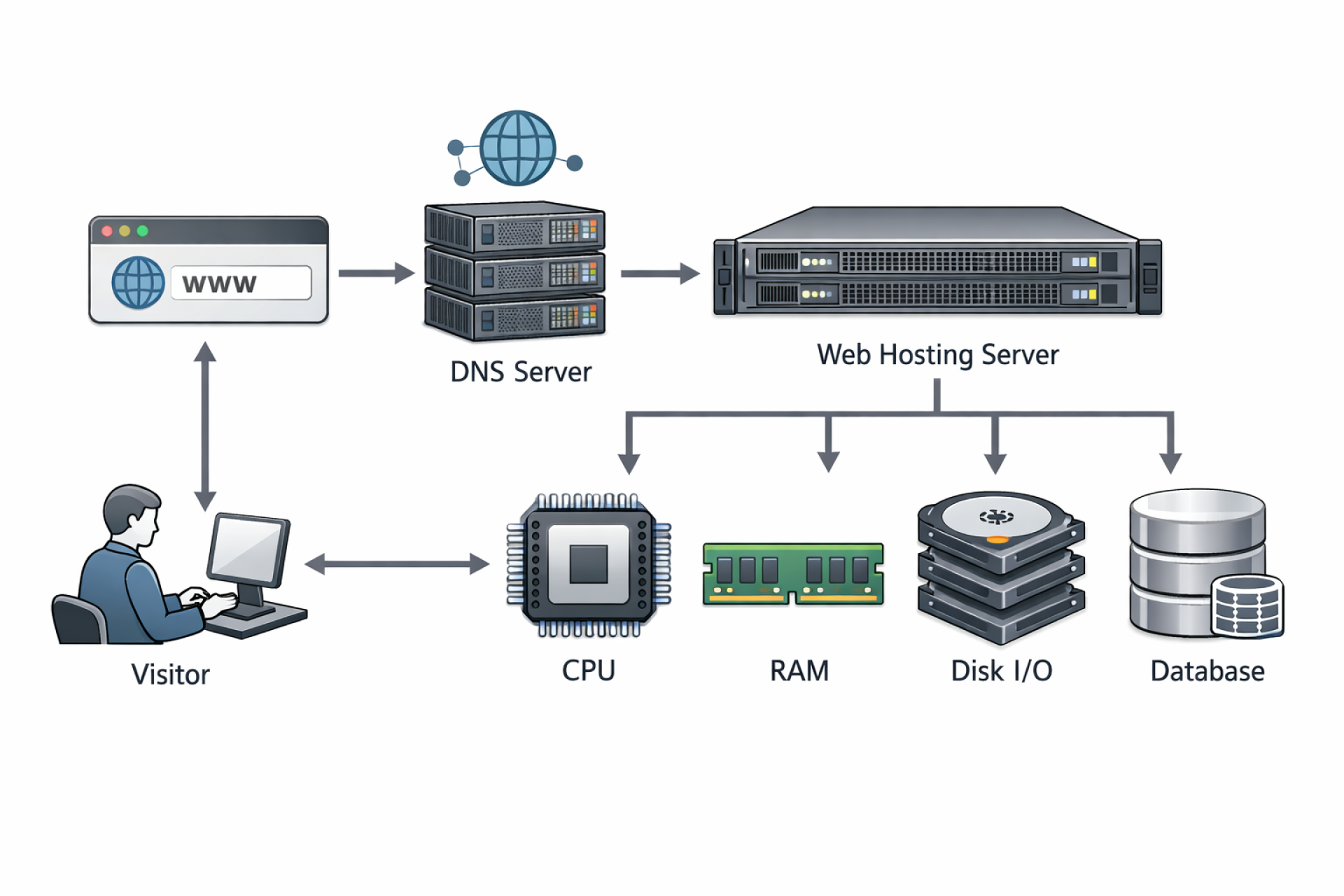
Web hosting is the service that stores a website’s files, databases, and application components on an internet-connected server so they can be accessed at any time.
Many users purchase hosting without fully understanding what it includes. Hosting is not just disk space; it is a combination of CPU power, memory, storage performance, network infrastructure, and server software working together.
When a user enters a domain name into a browser, the request is first sent to DNS servers. DNS identifies which server hosts the website and directs the browser to the correct hosting server.
This is where domain registration and web hosting services work together.
Each visitor request consumes server resources such as CPU, RAM, and Disk I/O. CPU processes scripts, RAM holds temporary data, and Disk I/O controls how fast files and databases are accessed.
If these resources are insufficient, websites become slow or unavailable.
In shared hosting environments, multiple websites run on the same physical server. Each site is allocated specific resource limits to prevent others from being affected.
This structure works well for small projects but may become insufficient as traffic grows.
Website performance depends on disk technology, server optimization, software configuration, and available resources. Dynamic websites rely heavily on database performance and server response time.
Poor hosting choices negatively impact SEO, user experience, and conversions. Search engines penalize slow websites, and visitors leave pages that load slowly.
Choosing the correct web hosting solution based on actual needs is essential for long-term success.
Web hosting is the foundation of any website. Domain names, DNS, server resources, and software layers must work together seamlessly to deliver content to users.

 Turkey (Türkçe)