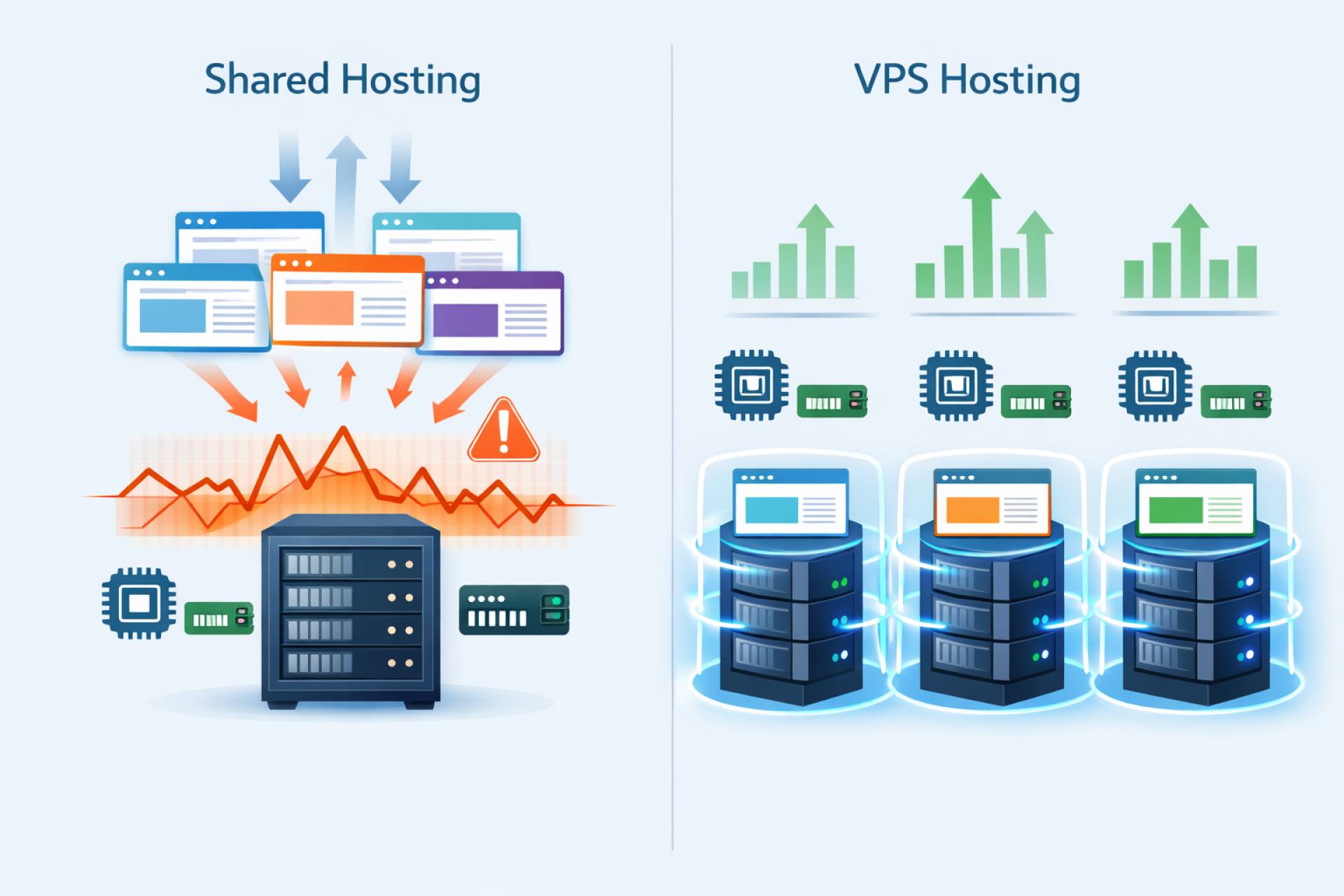
VPS (Virtual Private Server) is a hosting model created by dividing a physical server into multiple isolated virtual servers using virtualization technology. Each VPS has dedicated CPU, RAM, and storage resources.
Compared to shared hosting, VPS provides higher performance, greater control, and improved stability. It is commonly preferred by growing projects that require more predictable resources.
In shared hosting, multiple websites operate on the same physical server and share system resources. While this model is cost-effective, performance may fluctuate under heavy load.
With virtualization software, a physical server is segmented into independent virtual machines. Each VPS operates in isolation from others.
This isolation ensures that resource spikes on one VPS do not affect another.
Resource Allocation: Shared hosting uses common resources, while VPS guarantees dedicated allocations.
Performance: VPS offers more consistent performance under high traffic.
Control: VPS users may have root access and advanced configuration options.
Scalability: VPS plans are typically easier to upgrade.
If your website experiences steady traffic growth, frequent slowdowns due to resource limits, or requires custom server configurations, upgrading to VPS should be considered.
For e-commerce websites, API services, and resource-intensive applications, VPS hosting solutions provide a more suitable infrastructure.
Stable response times and reduced downtime contribute positively to SEO performance and user trust.
VPS stands between shared hosting and dedicated servers, offering a balanced combination of performance, flexibility, and cost efficiency for growing projects.

 Turkey (Türkçe)